
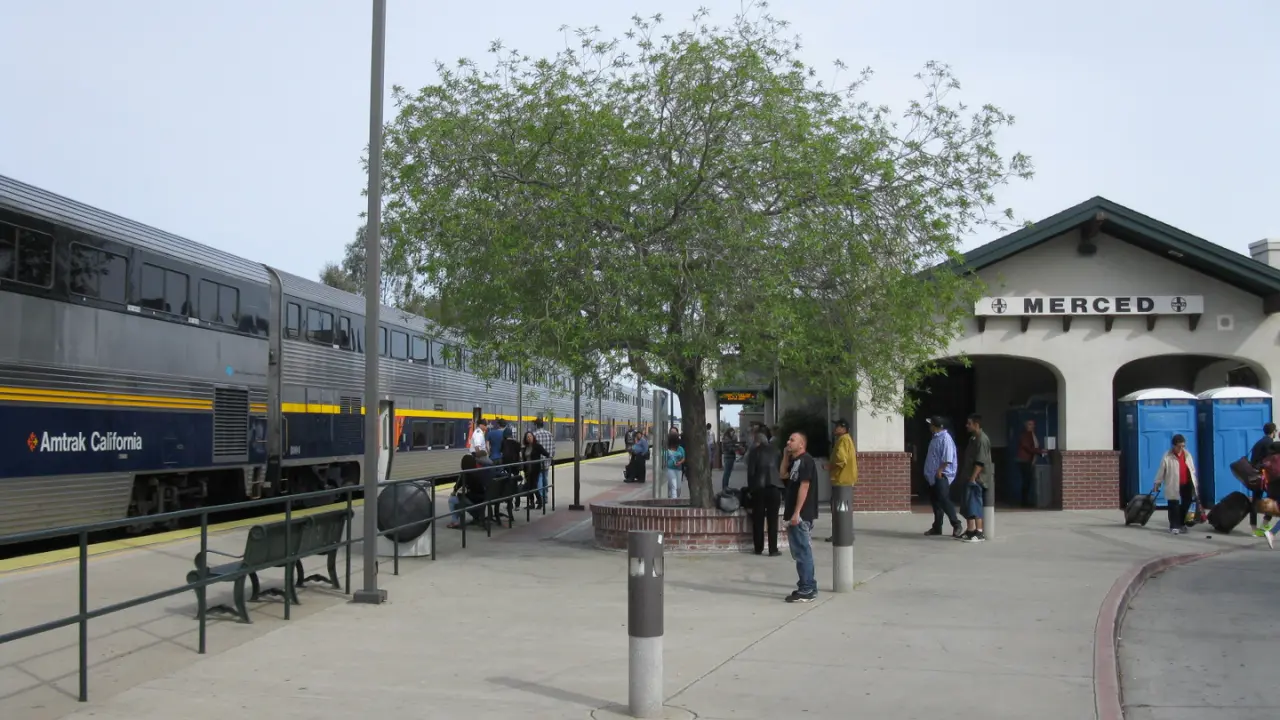
Merced is one of the busiest staffed stations in California’s San Joaquin Valley outside the metropolitan areas, handling 135,282 passengers in fiscal year 2025. It combines a full Amtrak ticket office with the bus connection that carries rail passengers into Yosemite National Park, which is why its traffic runs far ahead of the city’s size.
Merced — Live Arrivals & Departures
Updated 2 minutes ago · Times are localMerced Amtrak Station Location Accessibility and Contact Details
Amtrak lists the station at 324 West 24th Street, Merced, CA 95340, about four blocks northeast of Courthouse Square Park and a short distance south of Bear Creek and its parkland. The State of California owns the building and the lot; BNSF Railway owns the platform and the track.
Unlike most valley stops, Merced is staffed throughout the operating day. Amtrak publishes identical daily hours of 7:00 a.m. to 9:30 p.m. for the ticket office, passenger assistance, checked baggage and the Quik-Trak kiosks, and lists the ticket office, waiting room, restrooms and water fountain as accessible. A station wheelchair and a wheelchair lift are both kept on site.
Local and regional buses reach the station as well. The Bus, operated by Merced County Transit, serves the city and county, while the Yosemite Area Regional Transportation System runs the services that take rail passengers east toward the park.
| Station: | Merced Station |
| Station Code: | MCD |
| Contact Number: | 1-800-872-7245 |
| Lost and Found: | Online Form |
| Police: | +1-800-331-0008 |
| Working Hours: | Ticket office, passenger assistance and checked baggage daily 7:00 A.M. to 9:30 P.M. |
| Nearby Airport: | Merced Regional Airport (MCE) |
| Website: | https://www.amtrak.com/home |
| YouTube: | https://www.youtube.com/amtrak |
| Facebook: | https://www.facebook.com/Amtrak/ |
| Instagram: | https://www.instagram.com/amtrak |
| X (Twitter): | https://www.twitter.com/amtrak |
| LinkedIn: | https://www.linkedin.com/company/amtrak |
| Pinterest: | https://www.pinterest.com/amtraktravels/ |
Merced Amtrak Station Layout Map
Further, this is a detail-oriented visual representation of Amtrak’s Merced Station. With the help of this map, passengers can locate the ticket office, the waiting room and the bus loading area before arriving.
List of all Amtrak Stations.
Routes and Train Services
Trains at Merced run under the Gold Runner name, the state-supported service in the San Joaquin Valley that Amtrak operates and the San Joaquin Joint Powers Authority manages, with funding from the California Department of Transportation. As of 2025 the service runs seven daily round trips between Bakersfield and Stockton; five continue to Oakland and two to Sacramento.
Connecting buses extend that network well beyond the rails. The Yosemite-bound YARTS services are the best known, and it is the coordination between a train arrival and a bus departure, rather than the train frequency alone, that shapes most journeys through Merced.
Facilities and Amenities
Amtrak classifies Merced as a station building with a waiting room and lists a ticket sales office, restrooms, vending machines, payphones and Quik-Trak kiosks. Checked baggage service and checked baggage storage are both available, bag storage carries a fee, and bike boxes and shipping boxes are sold. Amtrak records no ATM, no elevator, no baggage carts and no Wi-Fi.
Parking at Merced is free. Amtrak lists same-day and overnight parking at no charge, including accessible spaces in both categories, which is unusual among California stations of this size.
Because the ticket office is open from 7:00 a.m. to 9:30 p.m. daily, Merced is one of the stops where tickets can still be bought in person and bags can be checked. Amtrak also records that unaccompanied minors may travel to and from this station, a permission it grants only where staff are present.
Passenger Experience
The building looks older than it is. A commemorative plaque records completion in 2000; the depot it resembles was an Atchison, Topeka and Santa Fe structure of 1917 that had fallen into disrepair, and city officials chose replacement over restoration to serve both rail passengers and Yosemite-bound bus traffic better.
DePertuis Scott Architects of Merced designed the replacement with deliberate reference to its predecessor, including an open-air waiting room of the kind long favoured in California and the Southwest, and brick and stucco as the main materials. The Rail Program of the California Department of Transportation paid for it.
Central Valley weather shapes the waiting experience more than the building does. Summer heat is severe, and the open-air element of the design means that shade and the indoor waiting room matter to passengers in a way they would not in a cooler climate.
Operational Reasoning Behind Service Structure
Service levels at Merced follow from the Gold Runner’s role as a state-funded corridor service rather than from local decisions. California specifies the frequencies and pays for them; Amtrak operates the trains and staffs the station to match.
The station functions efficiently because its facilities are matched to that role: a staffed counter and baggage service for a corridor with substantial walk-up and tourist traffic, but no lounge, no ATM and no Wi-Fi.
Merced’s position also reflects a wider valley pattern, in which rail serves a string of mid-sized cities and buses fill in the gaps toward the Sierra Nevada and the coast.
Travel Tips for Visitors
Amtrak’s own advice for Merced distinguishes between passengers with and without baggage to check:
- Arrive at least 45 minutes before departure when checking baggage or needing ticketing or passenger assistance
- Arrive at least 30 minutes before departure without baggage to check
- Confirm YARTS bus times separately, since Yosemite departures are far less frequent than trains
- Carry water in summer, because part of the waiting area is open-air by design
- Overnight parking is free at Merced, so a car can be left for the duration of a trip
Connection timing matters most. A missed YARTS departure can mean a long wait, because the Yosemite buses run far less often than the trains.
Regional Importance
The station links Merced County with Bakersfield, Fresno, Stockton, Sacramento and the Bay Area without a transfer, and its 135,282 annual passengers make it one of the most heavily used stops on the corridor.
It also functions as the rail gateway to Yosemite. The relationship is old: in 1907 the Yosemite Valley Railroad began running from Merced to the park entrance at El Portal, and the railroad built a large depot downtown opposite the Santa Fe station, which burned in 1929.
Rail and bus access reduces dependence on cars in a region where driving otherwise dominates, and it spreads park visitors across a corridor rather than concentrating them on the highways into the valley.
Future Outlook
Improvements at Merced have tended to be incremental. In 2011, under the Mobility First initiative funded through the American Recovery and Reinvestment Act, the stop received a new wheelchair lift and enclosure at an estimated cost of $29,700.
In June 2014 volunteers from the El Capitan Leo Club, the Clampers fraternity and other local organisations planted nearly 200 drought-resistant flowers and shrubs around the station, with Amtrak providing the funding — a reminder that the station’s upkeep is shared between the railroad, the state and the community.
FAQs
Amtrak lists the station at 324 West 24th Street, Merced, CA 95340, about four blocks northeast of Courthouse Square Park.
Amtrak takes station, fare and reservation calls on 1-800-872-7245. The Merced ticket office itself is staffed daily from 7:00 a.m. to 9:30 p.m.
Yes. Amtrak’s facility data for Merced lists unaccompanied child travel as allowed, which follows from the staffed ticket office on site.
Yes. Amtrak lists both checked baggage service and checked baggage storage at Merced, available daily from 7:00 a.m. to 9:30 p.m. Bag storage carries a fee.
Merced Yosemite Regional Airport (MCE), about two miles southwest of the city, is the nearest airport with scheduled commercial service, which the federal Essential Air Service programme subsidises.