 Aelric Novandar
Baggage rules on VIA Rail depend on two things: the fare and the route. The VIA Rail baggage allowance on a Québec City–Windsor Corridor train differs from the allowance on a long-distance train such as The Canadian. Passengers who check the rules before booking avoid extra fees and last-minute repacking at the station.
VIA Rail Baggage Policy
VIA Rail splits its service into two baggage systems.
- Corridor trains (Québec City–Windsor): No baggage car is attached to these trains, so passengers bring carry-on items only.
- Long-distance and regional trains: These trains have baggage cars, so passengers can check bags in addition to carrying some on board.
The VIA Rail baggage policy also states that passengers handle their own bags at the station and on board. Passengers carry only what they can lift and store themselves, under the seat or on the overhead rack.
VIA Rail Carry-On Baggage Allowance
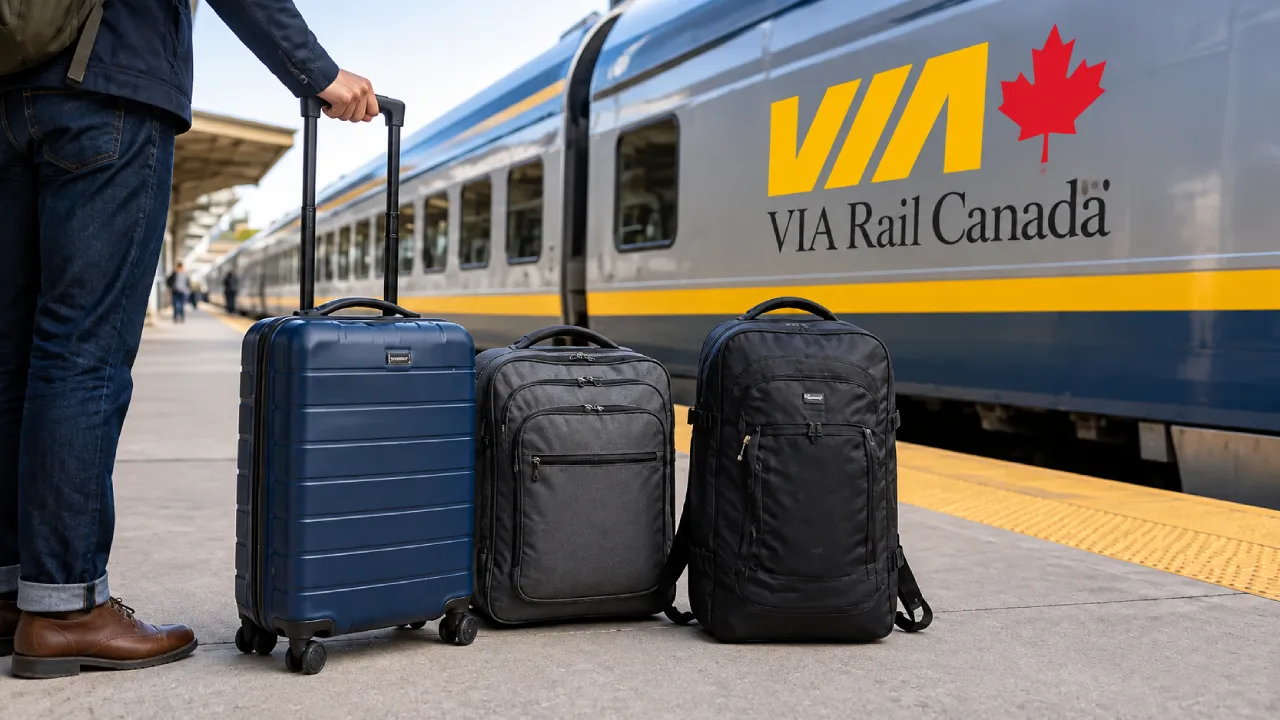
Every Corridor fare includes one personal item and one carry-on item. The personal item does not count towards the carry-on allowance.
Business and Business Plus fares include a larger item than the other fares. A second item is available for a fee on most fares. Space for additional carry-on bags is limited on every Corridor fare.
| Corridor Fare | Included carry-on | Additional carry-on |
|---|---|---|
| Escape (online only) | 1 item, up to medium | 1 item, up to large: $25 + tax |
| Economy | 1 item, up to medium | 1 item, up to large: $20 + tax |
| Economy Plus | 1 item, up to medium | 1 item, up to large: $15 + tax |
| Business | 1 item, up to large | 1 item, up to large: free |
| Business Plus | 1 item, up to large | 1 item, up to large: free |
Fees are per direction. Carry-on bags are allowed on every route, but the allowance differs between Corridor and long-distance trains. The table covers the Corridor only.
Carry-on items go under the seat, in the overhead bin, or on a designated rack. The personal item must fit under the seat.
NOTE: On long-distance and regional trains, all fares include one personal item and one medium carry-on item. Additional carry-on baggage is not permitted under the standard allowance; extra items must be declared and transported as checked baggage, where available.
Personal Item Allowance
A personal item is separate from the carry-on bag. VIA Rail’s examples are a purse, a laptop, or a small backpack. The item must fit under the seat.
The current published dimensions are 43 × 33 × 15 cm (17 × 13 × 6 in.), with a maximum weight of 11.5 kg (25 lb.) A larger backpack counts as carry-on baggage. The personal item sits outside the main VIA Rail carry-on baggage allowance for the fare, so it does not use up the carry-on item.
Children up to two years old have a baggage allowance based on the applicable policy for their ticket and journey. Check VIA Rail’s specific infant and toddler baggage conditions rather than assuming that a child travelling on a lap automatically receives an additional full adult allowance.
VIA Rail Baggage Size Restrictions
VIA Rail’s fare table groups carry-on items by size category. The categories are medium and large. Medium is the smaller of the two.
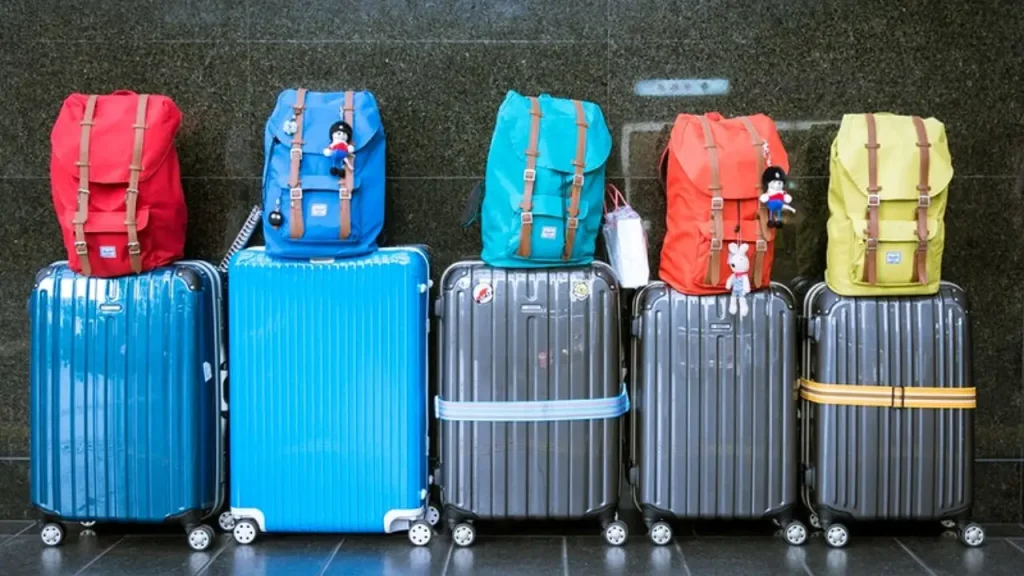
| Baggage Category | Maximum dimensions | Maximum Weight |
|---|---|---|
| Personal item | 43 x 33 x 15 cm | 11.5 kg |
| Medium carry-on | 64 x 41 x 30 cm | 23 kg |
| Large carry-on | 76 x 48 x 30 cm | 23 kg |
Maximum dimensions include wheels and handles. For non-standard-shaped items, VIA Rail may apply a linear-dimension limit of 154 cm (61 in.), calculated by adding length, width, and height.
Passengers who need to confirm whether a particular bag qualifies can check the allowance for their selected trip during online booking. The booking confirmation should also be checked for the applicable baggage allowance and whether checked baggage is available.
VIA Rail Baggage Weight Limit
VIA Rail ties limits on the number, size, and weight of items to the fare type. Passengers must comply with the allowance linked to their fare.
Checked baggage weighing between 23 and 32 kg (50 and 70 lb.) may be accepted with an overweight fee of $25 plus tax per item and direction. The maximum accepted weight is 32 kg (70 lb.). Checked bags between 154 and 180 linear cm are charged an oversized fee of $25 plus tax per item and per direction. This overweight provision applies to checked baggage, not Corridor carry-on baggage.
Items exceeding the permitted allowance can result in additional charges or refusal. On long-distance and regional routes, baggage space is limited, so passengers should declare additional items in advance.
VIA Rail Luggage Fees
Fees depend on the route and the fare.
- Corridor, additional carry-on: $25 (Escape), $20 (Economy), or $15 (Economy Plus), plus tax. Business and Business Plus passengers pay nothing.
- Long-distance, additional checked bag: $40 plus tax for passengers on the Escape, Economy, or Economy Plus fare.
- Sports or recreational item: One item is allowed in addition to the standard allowance, for an extra fee.
The VIA Rail baggage fees appear on the fare comparison page, and Rail recommends adding extra bags before arriving at the station. If the chosen train has no space left, VIA Rail offers another departure with room.
Passengers who add an extra bag at booking pay the posted fee for it. A passenger who arrives with an undeclared extra bag may be refused permission to travel with it.
VIA Rail Checked Baggage Policy
Under the VIA Rail baggage policy, checked bags are not carried on Corridor trains, because those trains have no baggage cars. Long-distance and regional trains do offer the service, and checked bags travel in the baggage car.
| Long-distance Fare | Included checked baggage | Additional checked bag |
|---|---|---|
| Escape (online only) | 1 item, up to large | $40 + tax |
| Economy | 1 item, up to large | $40 + tax |
| Economy Plus | 1 item, up to large | $40 + tax |
| Sleeper Plus | 2 items, up to large | 2 included free |
| Touring | 2 items, up to large | 2 included free |
| Prestige | 2 items, up to large | 2 included free |
For connections to The Canadian, only one checked bag is allowed.
Each of these fares also includes one carry-on item, up to medium. Maximum standard checked-bag dimensions: 76 × 48 × 30 cm (30 × 19 × 12 in.). Maximum standard weight: 23 kg (50 lb.) per item.
Drop-off deadlines for checked bags:
- Terminal stations: no later than 45 minutes before departure.
- Intermediate stations: no later than 30 minutes before departure.
Each bag needs a tag with the passenger’s name, home address, phone number, and email. Passengers can confirm that checked baggage is offered on a given train at booking, since the VIA Rail checked baggage service varies by route.
Long-Distance and Regional Routes
Carry-on baggage is allowed on all long-distance and regional routes. Anything beyond the basic carry-on allowance must be checked and goes into the baggage car.
Passengers must declare every additional bag at booking, including sports equipment. Only items in the basic allowance are exempt from declaration. The VIA Rail Canada baggage policy on these routes depends on available space, so undeclared bags may be refused.
VIA Rail Oversized Baggage Rules
VIA Rail allows certain sports and recreational items beyond the standard baggage allowance, subject to route-specific conditions, fees, size limits, and available space.
Examples include:
- Golf bags.
- Skis.
- Snowboards.
- Nautical boards.
- Hockey bags.
For several of these items, the published fee is $25 per item per direction. However, not all sports equipment has the same conditions. For example, bicycles have specific route restrictions and handling requirements
A folding bicycle can be brought on board and counts as one item of the carry-on allowance, up to 158 linear cm. It gets no extra slot and is not charged the sports fee. Other bicycles have route restrictions and handling requirements.
Prohibited Items and Special Items in Luggage
VIA Rail has a separate Special Items page for non-standard items such as batteries, coolers, propane, gasoline, pharmaceutical products, and firearms. Each item has its own conditions. VIA Rail also reserves the right to inspect all baggage for passenger safety. The VIA Rail baggage restrictions apply to both carry-on and checked bags, so items in these categories need a check on that page before packing.
Travelling With a Partner Carrier
Baggage rules change on trips operated with a partner. On cross-border Amtrak services, the partner carrier’s baggage policy may apply instead of VIA Rail’s standard policy. Amtrak’s rules may differ, and its website lists the limits.
Storage, Assistance, and Lost Items on VIA Rail
- Luggage storage: Some stations have a checkroom, a secured area with controlled access. It requires a confirmed ticket for a same-day departure. The checkroom is separate from the VIA Rail baggage allowance, which governs what travels on the train.
- Assistance: Help with bags is limited to passengers with specific needs or approved accessibility requests. VIA Rail provides this help free of charge.
- Damaged bags: Passengers report the damage to an agent at the baggage counter before leaving the station. The agent supplies the claim form. Photos and receipts support the claim.
- Lost or stolen bags: The Lost and Found line is 1-888-842-7245 (TTY 1-800-268-9503). Reports can also be made at the station ticket counter.
- Items left on a train: Passengers report the item at the baggage or ticket counter on arrival.
- Liability: Passengers are responsible for their carry-on baggage at all times. VIA Rail’s conditions of contract state that it assumes limited liability for loss of or damage to checked baggage.
The VIA Rail baggage allowance follows the fare and the route. Corridor trains allow carry-on items only, with one included item and a fee for a second on most fares. Long-distance trains add checked baggage, with one or two checked items included and $40 plus tax for an extra bag. Passengers who declare extra bags at booking, label every bag, and read the baggage pages for their route avoid most problems on the day of travel.
Frequently Asked Questions
No. Without baggage cars, Corridor trains cannot carry checked bags, so passengers use carry-on items only. The VIA Rail baggage policy for long-distance trains allows checked bags.
On Corridor trains, the extra item costs $25 on Escape, $20 on Economy, and $15 on Economy Plus, plus tax, per direction. Business and Business Plus include it at no charge. Space is limited, and the VIA Rail baggage allowance shown at booking confirms the fee.
No later than 45 minutes before departure at terminal stations and 30 minutes before at intermediate stations. This applies to long-distance and regional trains.
A personal item must fit under the seat and measure no more than 43 × 33 × 15 cm (17 × 13 × 6 in.). Its maximum weight is 11.5 kg (25 lb.).
Certain items, such as skis, a snowboard, a golf bag, or a nautical board, can travel for an extra fee and must be declared at booking. A folding bike counts as one item of the carry-on allowance instead. Conditions vary by item, so check VIA’s sports equipment page.
The Lost and Found line is 1-888-842-7245, and reports can also be made at the station ticket counter. VIA Rail asks passengers to report a forgotten item on arrival at the station.