
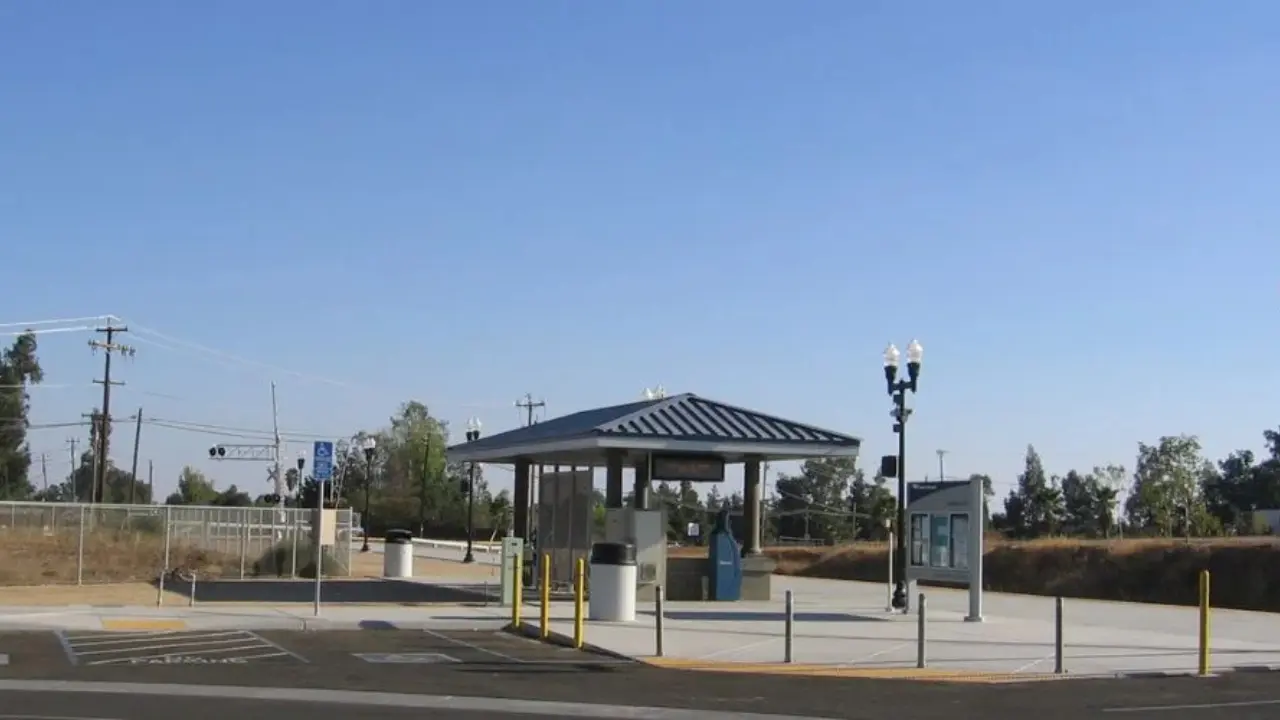
Madera station (code MDR) is a platform stop in California’s Central Valley, and it is not in Madera. The stop stands about four miles north of downtown at the crossing of Road 26 and the BNSF tracks, in the Madera Country Club Estates area, having been moved there in November 2010 from an older location three miles to the southeast.
Amtrak lists no station building at Madera. A 400-foot concrete platform with an open-air shelter is the whole facility, yet it handled 25,464 passengers in fiscal year 2025 — more than nine times the traffic at Lodi on the same route.
Madera — Live Arrivals & Departures
Updated 10 seconds ago · Times are localVisiting Madera Amtrak Station: Access, Location & How to Reach
The station is located at:
18770 Road 26, Madera, CA 93638, United States
Although the stop carries the city’s name, the setting is rural. Madera County owns the platform, the shelter and the parking area, BNSF Railway owns the track, and the city of Madera agreed to maintain the platform and shelter as part of the deal that built them.
| Station: | Madera Station |
| Station Code: | MDR |
| Contact Number: | 1-800-872-7245 |
| Lost and Found: | Online Form |
| Police: | +1-800-331-0008 |
| Working Hours: | No staffed hours — unstaffed station, and Amtrak publishes no waiting-room hours for this stop |
| Nearby Airport: | Fresno Yosemite International Airport (FAT) |
| Website: | https://www.amtrak.com/home |
| YouTube: | https://www.youtube.com/amtrak |
| Facebook: | https://www.facebook.com/Amtrak/ |
| Instagram: | https://www.instagram.com/amtrak |
| X (Twitter): | https://www.twitter.com/amtrak |
| LinkedIn: | https://www.linkedin.com/company/amtrak |
| Pinterest: | https://www.pinterest.com/amtraktravels/ |
Madera Amtrak Station Layout Map
Further, this is a detail-oriented visual representation of Amtrak’s Madera Station. With the help of this map, passengers can have a hassle-free navigation experience. The entry and exit points of Amtrak can also be figured out conveniently.
How to Reach Madera Amtrak Station
Reaching the platform takes planning, because it sits outside the built-up area:
- By private car: the usual choice, with same-day and overnight parking listed as available for a fee
- Rideshare or taxi: available from Madera, though waits are longer this far from town and a return trip needs arranging
- Local buses: Madera County Connection routes serve the city, but no scheduled service reaches the platform itself
Confirming transport in both directions matters here more than at most stops, since the platform is four miles from downtown and trains call early and late in the day.
Train Services and Route Connectivity
Madera is served by one rail route and by the connecting coach network that extends it. The trains ran as the San Joaquins until 3 November 2025, when the San Joaquin Joint Powers Authority rebranded the service Gold Runner, uniting rail and Thruway bus travel under a single name.
Main Services Linked to the Station
- Gold Runner Route: the state-supported service between Bakersfield and Oakland or Sacramento, known as the San Joaquins until November 2025
- Amtrak Thruway Bus Connections: coaches linking the corridor to Los Angeles, the Bay Area, Yosemite and the Sierra
That combination lets passengers from a rural stop reach Los Angeles, the Bay Area and Yosemite with one booking, even though no long-distance train calls at Madera itself.
Facilities and Amenities at the Station
Amtrak lists a short set of facilities at Madera, and two entries in its own data contradict each other, which is worth knowing before relying on either.
Available Amenities
- A 400-foot concrete platform, which Amtrak lists as accessible
- An open-air shelter built with the platform in 2010
- Same-day and overnight parking, with fees possible
- A wheelchair lift kept at the stop for boarding assistance
Facilities Not Available
- No ticket counter and no station staff at any hour
- No restrooms in Amtrak’s facility list, which its accessibility list contradicts
- No indoor waiting room, since there is no building
- No food, vending machines or Wi-Fi
Amtrak’s facility list says there are no restrooms at Madera while its accessibility list says accessible restrooms are available; the kiosk entries conflict in the same way, with no Quik-Trak machines listed yet kiosk hours given as 24 hours a day. Neither contradiction has been resolved in Amtrak’s published data, so tickets are best bought in advance and other arrangements made for a long wait.
Passenger Experience at Madera Amtrak Station
Travel through Madera is quiet and self-directed. The platform is open to the weather, the surroundings are agricultural, and no member of staff is present at any hour.
What Travelers Typically Experience
- A quiet, uncrowded setting among orchards and vineyards
- No announcements and no on-site assistance
- Short station stops that require being ready to board
- Reliance on a phone for tickets, times and delay information
Self-sufficiency is the main requirement: a downloaded ticket, a charged phone and attention to the arrival time cover almost everything the stop does not provide.
Why the Station Operates This Way
The form of the stop follows from how it was funded and from who owns the railroad it sits on.
Key Operational Factors:
- Low local demand: the surrounding area does not support frequent service
- Freight-owned track: BNSF Railway owns the line through Madera
- Cost efficiency: a platform and shelter cost a fraction of a staffed depot
- Shared responsibility: the county owns the site and the city maintains it
The arrangement trades amenities for access, which is the standard bargain on a state-supported corridor.
Historical Context
Rail reached this part of the San Joaquin Valley to move agricultural freight, and passenger stops were later added along existing corridors rather than built where towns had grown. Madera, at the center of a district known for figs, pistachios and raisins, gained a modest platform with a bench on that basis.
City officials began planning a replacement in the early 2000s, and state budget problems held the funding until the end of the decade. The $2 million project drew $244,000 from Madera County’s Measure T transportation sales tax, $800,000 from the state of California and the remainder through the California Transportation Commission. When the first train pulled up to the new platform in November 2010, the locomotive broke through a paper banner reading “Madera: The Train Stops Here.”
Regional Importance of Madera Amtrak Station
For a stop with no building, Madera carries real traffic, and much of it is travel that would otherwise be made by car on Highway 99.
Its Importance Includes:
- Mobility for residents without a car
- A link between rural Madera County and larger California cities
- Access to jobs and services in Fresno, Sacramento and the Bay Area
- An alternative to driving Highway 99 the length of the valley
The platform also serves visitors heading for Yosemite and Kings Canyon, for which Madera is a common entry point by road.
Travel Tips for Passengers
Planning ahead counts at an open platform four miles from town.
Useful Tips
- Arrive 20 to 30 minutes before departure
- Buy and download tickets in advance, since no agent or reliable kiosk exists
- Check train and Thruway bus connections together, as many trips use both
- Carry water, food and shade in summer, when valley afternoons pass 100 degrees
- Arrange a ride to and from the platform, which is four miles from downtown
These steps matter because Amtrak lists no staff, no indoor waiting room and no reliable on-site facilities at this stop.
Future Outlook
California continues to invest in Central Valley rail, and the Gold Runner rebranding of November 2025 came with a broader push to unify trains and connecting buses. Any work at Madera is likely to be incremental.
- A larger or enclosed shelter
- Closer timing between trains and connecting buses
- Real-time arrival displays on the platform
Significant expansion is unlikely unless demand rises sharply or a wider valley rail project changes where trains stop.
FAQs
At 18770 Road 26, Madera, CA 93638, about four miles north of downtown at the crossing of Road 26 and the BNSF tracks. The stop moved to this site in November 2010 from a location three miles to the southeast.
No. Amtrak lists no ticket office and no passenger assistance at Madera. Its data is inconsistent about Quik-Trak kiosks, listing none while also giving kiosk hours of 24 hours a day, so tickets should be bought in advance.
One rail route, the state-supported service between Bakersfield and Oakland or Sacramento that was called the San Joaquins until 3 November 2025 and is now branded Gold Runner, plus connecting Amtrak Thruway buses.
There is no building and no indoor waiting room, only a 400-foot platform with an open-air shelter. Amtrak lists no restrooms in its facility data while listing accessible restrooms in its accessibility data, a contradiction it has not resolved.
Amtrak asks for at least 30 minutes before departure at Madera. Because the platform is four miles from downtown and has no indoor space, arranging transport for both directions matters as much as the arrival time.