
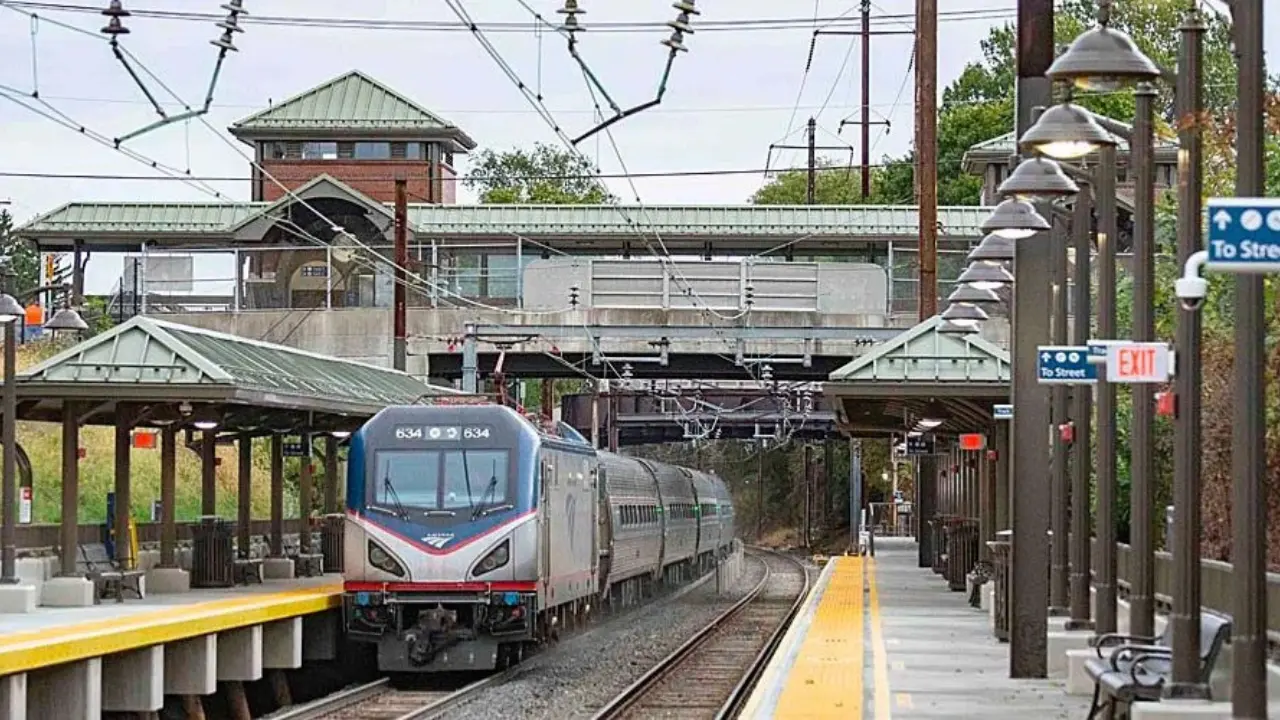
The Mount Joy Amtrak Station functions as a small regional stop along Pennsylvania’s Keystone Corridor. Its design reflects a practical approach to rail service in a semi-rural town where passenger demand remains steady but not high enough to justify a large terminal.
Commuter movement defines the station’s role. Most activity centers around daily travel toward Harrisburg, Philadelphia, and New York City. Because of this pattern, infrastructure remains minimal and focused on speed of boarding rather than extended waiting or commercial services.
Location and Accessibility
The Mount Joy Amtrak Station sits at 50 East Main Street, Mount Joy, PA 17552, United States, positioned close to the borough’s central roadway network. This placement reduces travel time for local residents while keeping the station aligned with the main rail corridor.
Road access is straightforward through Route 230 and nearby connections to Route 283. As a result, the station integrates into regional commuting patterns rather than acting as a standalone transport hub.
Pedestrian access is also common due to the compact layout of Mount Joy. However, public transit options remain limited, which explains why private vehicles and rideshare services dominate station access patterns. Parking availability is modest and primarily supports short-duration commuter use.
| Station: | Mount Joy Station |
| Station Code: | MJY |
| Contact Number: | 1-800-872-7245 |
| Email: | etickets@amtrak.com |
| Lost and Found: | Online Form |
| Police: | +1-800-331-0008 |
| Working Hours: | Monday to Sunday from 09:30 AM to 06:30 PM |
| Nearby Airport: | Harrisburg International Airport (MDT) |
| Website: | https://www.amtrak.com/home |
| YouTube: | https://www.youtube.com/amtrak |
| Facebook: | https://www.facebook.com/Amtrak/ |
| Instagram: | https://www.instagram.com/amtrak |
| X (Twitter): | https://www.twitter.com/amtrak |
| LinkedIn: | https://www.linkedin.com/company/amtrak |
| Pinterest: | https://www.pinterest.com/amtraktravels/ |
Mount Joy Amtrak Station Layout Map
Further, this is a detail-oriented visual representation of Amtrak’s Mount Joy Station. With the help of this map, passengers can have a hassle-free navigation experience. The entry and exit points of Amtrak can also be figured out conveniently.
Rail Services and Operational Structure
Rail operations at the Mount Joy Amtrak Station are shaped by its position on the Keystone Corridor. This corridor prioritizes fast intercity connectivity over local stop density, which explains the selective train service pattern.
Key service characteristics include:
- Keystone Service trains operating between Harrisburg and New York City
- Stops aligned with commuter demand rather than every passing train
- Higher frequency during weekday peak travel hours
- Reduced but consistent weekend service
The operational structure reflects efficiency requirements. Stopping patterns are carefully managed so that travel times between major cities remain competitive with road and air transport. As a result, not all long-distance Amtrak services include this stop.
Facilities and Station Layout
Facilities at the Mount Joy Amtrak Station remain intentionally basic. The design prioritizes function over comfort, which aligns with its commuter-focused role.
Available features include:
- Open platform structure with weather exposure
- Covered shelter for limited protection
- Seating benches along the platform
- Ticketing handled entirely online or via mobile systems
- ADA-accessible boarding platform
The absence of a staffed station building is not accidental. Instead, it reflects low passenger volume and cost-efficient operational planning. No restrooms, retail outlets, or indoor waiting rooms are provided, which encourages shorter dwell times and reduces maintenance requirements.
Historical Context and Rail Development
Rail infrastructure in Mount Joy traces back to the Pennsylvania Railroad era. The corridor that supports today’s Mount Joy Amtrak Station originally formed part of a larger freight and passenger network that connected major industrial cities across the Northeast.
Over time, passenger rail service shifted from large staffed depots to smaller platform-based stops. This transition occurred due to changes in transportation habits, especially the rise of automobile travel and highway expansion. The current station structure represents this evolution, where efficiency replaced architectural scale.
Passenger Experience and Daily Use
Travel conditions at the Mount Joy Amtrak Station reflect its commuter-oriented design. Passenger flow remains predictable, with peak activity occurring during morning and evening travel windows.
Boarding typically follows a simple sequence:
- Arrival at platform based on schedule timing
- Brief wait under sheltered areas
- Direct boarding once trains arrive
Limited infrastructure shapes passenger behavior. Since no staff assistance is present, travelers rely on digital schedules and pre-purchased tickets. This system reduces delays but also requires prior planning.
Weather exposure influences comfort levels, especially during winter and heavy rain. However, short waiting times reduce the impact of minimal sheltering.
Why the Station Operates in a Minimal Format
Operational design at the Mount Joy Amtrak Station follows demand-based efficiency principles. The station exists primarily because it supports regional mobility, not because it functions as a major transport hub.
Several factors explain its structure:
- Passenger volume remains moderate compared to nearby Lancaster or Harrisburg
- Train schedules must remain efficient across long corridor distances
- Staffing small stations increases operational costs without proportional benefit
- Nearby larger stations absorb extended passenger services
Therefore, infrastructure remains streamlined. The focus stays on maintaining connectivity rather than expanding station complexity.
Travel Planning Considerations
Effective use of the Mount Joy Amtrak Station depends on preparation and timing awareness. Since on-site services are limited, most travel steps occur before arrival.
Key planning considerations include:
- Ticket purchase completed in advance to avoid delays
- Arrival scheduled slightly ahead of train departure times
- Weather conditions reviewed due to open-air platform design
- Parking availability checked during peak commute hours
Additionally, train punctuality generally remains strong due to corridor prioritization. However, external delays can still occur, so schedule flexibility improves travel reliability.
Regional Role in Transportation Network
The Mount Joy Amtrak Station contributes to regional connectivity by linking smaller communities to larger urban centers. This connection supports commuting patterns, educational travel, and regional economic interaction.
Its importance becomes clearer when viewed within the broader Keystone Corridor system. Instead of serving as a destination hub, the station functions as an access point that reduces dependence on highways and personal long-distance driving.
Consequently, it supports both environmental and congestion-reduction goals indirectly, even without large infrastructure investments.
Future Outlook
Long-term development for the Mount Joy Amtrak Station is expected to remain incremental rather than transformative. Large-scale expansion is unlikely due to stable but limited demand.
Future improvements may focus on:
- Enhanced accessibility features
- Updated signage and digital information systems
- Minor platform safety upgrades
- Adjustments to parking organization
These changes would aim to improve usability without altering the station’s fundamental commuter role.
FAQs
It is located at 50 East Main Street, Mount Joy, PA 17552, United States, near the borough’s central area.
Keystone Service trains running between Harrisburg, Philadelphia, and New York City serve the station regularly.
No staffed counters exist. Ticketing is handled through online or mobile platforms only.
Basic facilities include a platform, sheltered seating, parking, and ADA accessibility, with no indoor services.
Limited passenger demand and corridor efficiency requirements reduce the need for expanded facilities or staffing.